
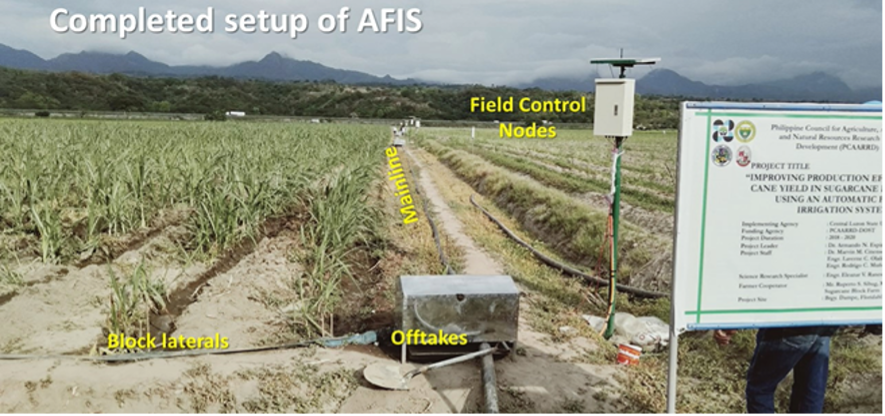
The Automated Furrow Irrigation System or AFIS helps save water and improve sugarcane yield.
This highlights the result of the recently completed project implemented by Central Luzon State University (CLSU). Results were explained by CLSU project leader Dr. Armando N. Espino, Jr. during a webinar on sugarcane production recently organized by the Philippine Council for Agriculture, Aquatic and Natural Resources Research and Development of the Department of Science and Technology (DOST-PCAARRD).
Dr. Espino said, automating traditional furrow irrigation systems eases the farmers’ burden from labor-intensive irrigation activities. It ensures that irrigation water is applied at a precise amount and time. Water is used more efficiently and productively leading to a lower pumping cost.
Dr. Espino further said that results of field trials in a 1.5-hectare farm at Brgy. Dampe, Floridablanca, Pampanga showed that with AFIS, the height of sugarcane stalks was higher. With AFIS, yield was 58% higher than that in the conventional furrow irrigation system, water savings was high at 47%, and water productivity or yield per unit volume of water used was also high at 132.87 kilogram per cubic meter (kg/m3).
He also reported positive results of computational analysis of the juice extracted from the harvested sugarcane. The amount of sugar that can be recovered per ton-cane is higher at 1.98 Lkg/TC compared with that from the conventional furrow irrigation system with only 1.48 Lkg/TC. Lkg/TC means 50kg sugar per ton-cane.
This PCAARRD-funded project was conducted in coordination with Dampe Palay and Sugarcane Producers Cooperative in Pampanga. PS862 sugarcane variety with a planting density of 30,000 cane points per hectare (ha) was used in the experiment.
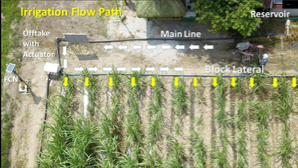
AFIS is composed of the main controller, field control nodes, soil moisture sensors, water advance flow sensors, and other minor components. A CLSU-developed mobile application remotely controls the opening and closing of the valve. The valve opens when the soil moisture level reaches its threshold value and stops at a cut-off time determined automatically by the system.
With AFIS, Dr. Espino said that water savings of 2,020 cubic meter per hectare (m3/ha) can be generated. Hence, labor cost for irrigation becomes lower due to automation. With a computed yield of 178.13 TC/ha and Lkg/TC of 1.98, net income is estimated at P179,528.77/ha. Benefit cost ratio (BCR) in AFIS is higher at 2.88 than in the conventional furrow irrigation system with only1.45. As such, AFIS is worth the investment in the long run. (Ofelia F. Domingo, DOST-PCAARRD S&T Media Services).